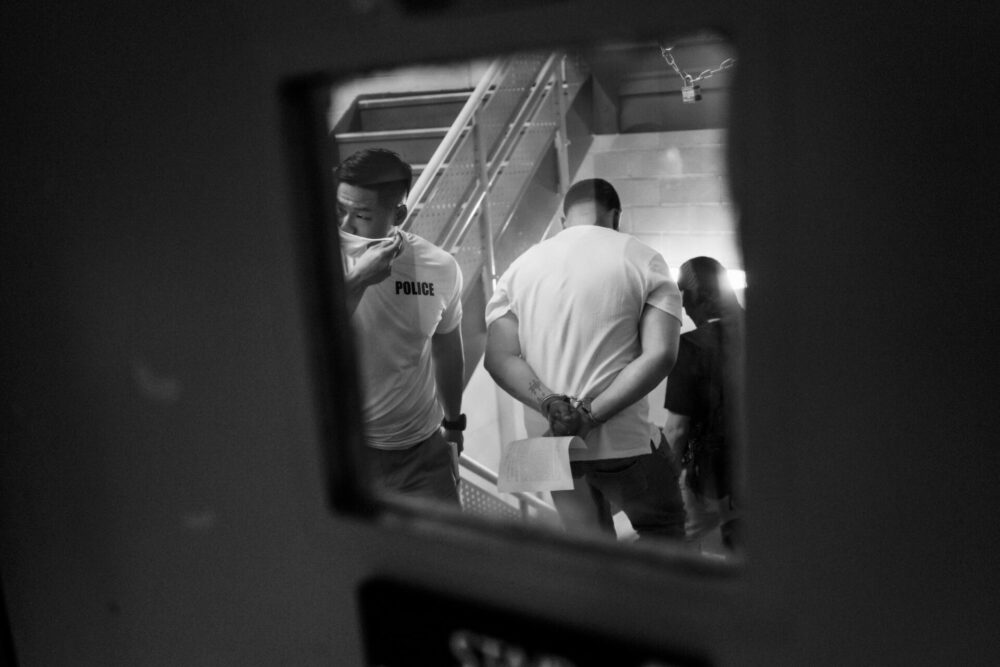

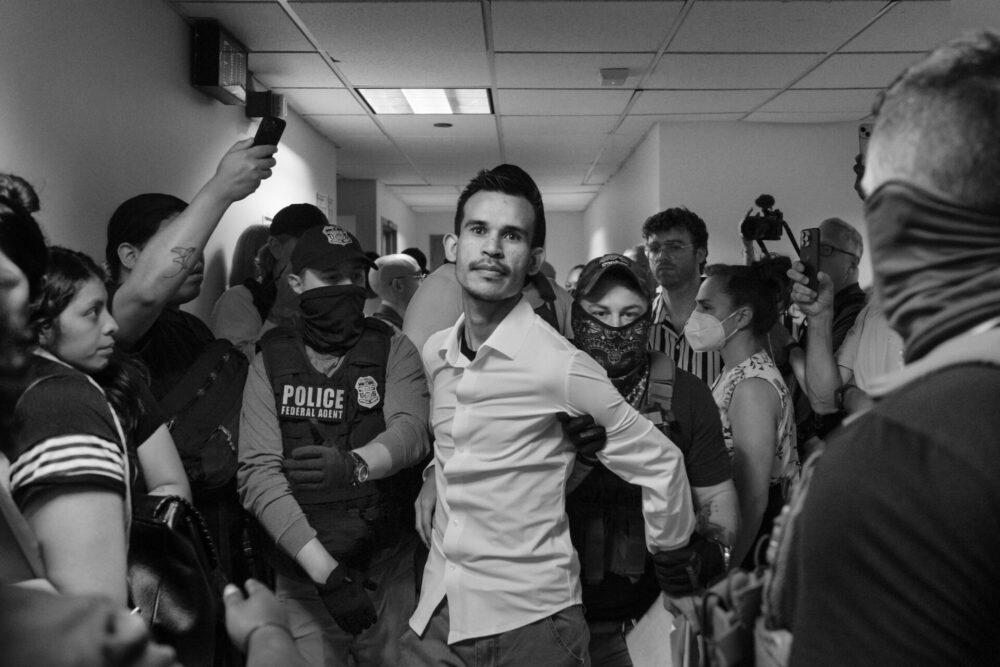
ICE agents detain a man in the hallway of the Jacob K. Javits Federal Building, located at 26 Federal Plaza in Manhattan, immediately after his hearing. Arrests like this occur even when respondents comply with court proceedings, a practice immigrant rights groups call “courthouse arrests.” While some families walk out together, others vanish into detention, often transferred to Hudson County Correctional Facility in New Jersey or Orange County Jail in New York. In FY 2025, ICE reported holding over 59,000 people in detention on a given day, nearly half with no criminal record. In New York City, more than 30% of ICE arrests between May and June 2025 occurred inside courthouses. © Nicolò Filippo Rosso

In The Name Of The Law -Inside the U.S. Immigration System

Nicolò Filippo Rosso

2025 – Ongoing — New York City, NY – USA

About this series

This series documents daily arrests at immigration courts in downtown Manhattan. Federal agents enforce ICE operations. Since May, asylum seekers have been detained after leaving court on their hearing days, regardless of judges’ decisions. Since June, I have spent nearly every weekday inside the courts at 26 Federal Plaza and 290 Broadway. Each day, ICE agents detain non-U.S. citizens attending hearings—many with Temporary Protected Status or pending asylum claims. They complied with the system, yet were seized in hallways, arrested, transferred to distant detention centers, and placed on paths to deportation.
This work continues my long-term documentation of migration across the Americas. Since 2018, I have photographed in Venezuela, Colombia, and throughout South America, then moved north through Central America and Mexico. I met families on the move and recorded their fragile steps toward safety. By 2024, I reconnected with some in the United States. What they hoped would end their journey had become a new cycle of fear.
Inside the courthouses, masked agents in bulletproof vests move with practiced indifference. Weapons glint under fluorescent lights as they surround targets, usher them toward elevators or hidden exits, and disappear into windowless corridors. Children cry. Parents are taken. Spouses emerge alone. By mid-August, attendance fell as people requested online hearings, yet policy changes forced in-person appearances, leaving respondents exposed to agents waiting outside.
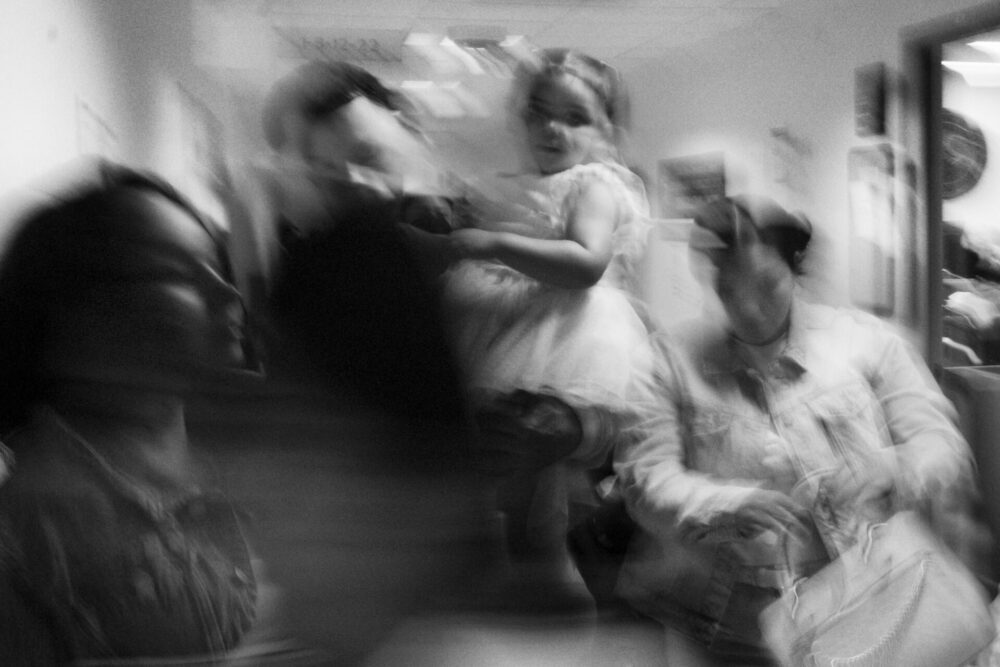
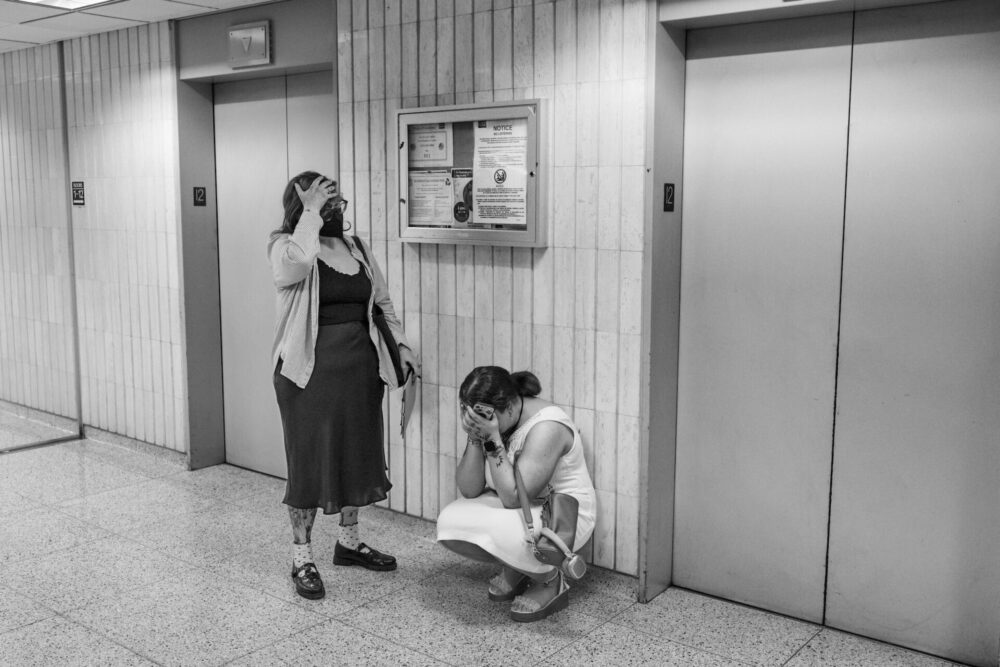
A family leaves a courtroom in the Jacob K. Javits Federal Building, at 26 Federal Plaza, after their hearing, relieved to walk free for the day. In the same hallways, others are taken into custody and transferred to county jails under ICE contracts. By August 2025, the immigration court backlog had surpassed 3.4 million cases, including nearly 2.3 million asylum applications. The outcome of a hearing can divide families — for some, freedom; for others, disappearance into detention.© Nicolò Filippo Rosso
At the Jacob K. Javits Federal Building, at 26 Federal Plaza in Manhattan, a U.S. citizen breaks down in grief as her husband, a Peruvian national, is taken into ICE custody moments after his hearing. Arrests like this divide thousands of mixed-status families each year. While some walk free after their cases, others are transferred to detention facilities across the nation. By August 2025, the immigration court backlog reached 3.4 million cases, with nearly 2.3 million asylum applications pending. Studies show that about 5.9 million U.S. citizen children live with at least one undocumented parent, leaving families like this one vulnerable to sudden separation in courthouse hallways. © Nicolò Filippo Rosso
After his hearing in the Jacob K. Javits Federal Building, at 26 Federal Plaza, a respondent is led away in handcuffs by federal officers. Many individuals detained in courthouse hallways have no criminal record and appear to be there only to pursue their cases. Most are transferred to county jails under ICE contracts, such as Hudson County Correctional Facility in New Jersey or Orange County Jail in New York. By mid-2025, ICE detention reached nearly 60,000 people on any given day, the highest level ever recorded. Almost half were held without any conviction, underscoring how routine hearings can end in sudden arrest and confinement. © Nicolò Filippo Rosso
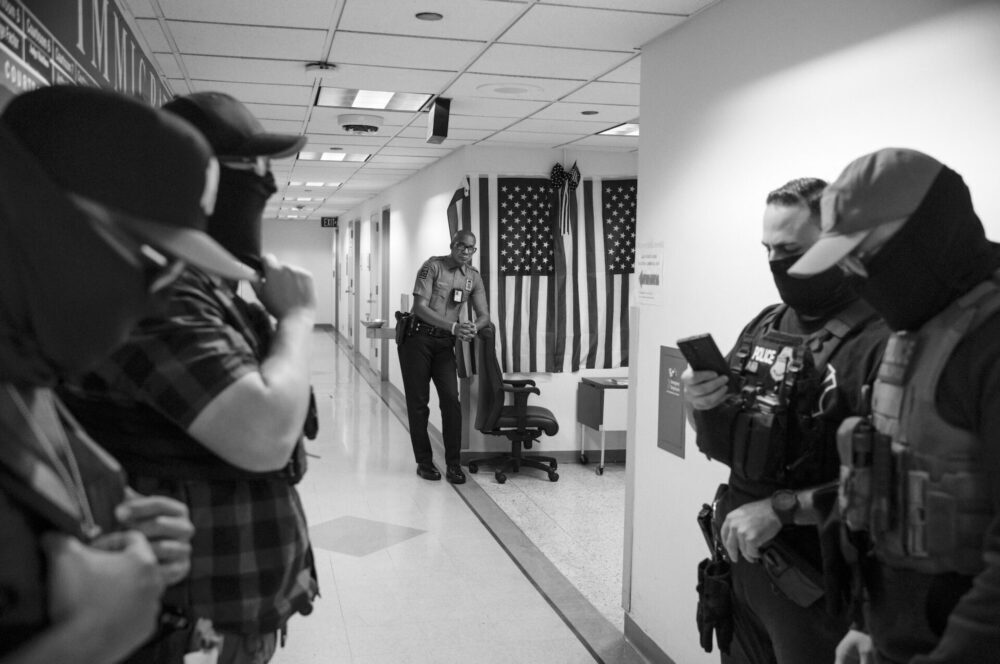
At the Jacob K. Javits Federal Building, at 26 Federal Plaza in Manhattan, masked federal agents stand outside a courtroom, waiting to identify respondents as they leave their hearings. Their presence turns the courthouse into a staging ground for arrests, where compliance with the legal process exposes migrants to immediate detention. In 2025, civil rights groups warn that the use of heavily armed, masked agents in civilian spaces reflects a shift toward authoritarian policing practices. Inside the courthouse, the line between due process and enforcement collapses. At the same time, detainees are quickly transferred into distant ICE detention centers across the U.S. Families, lawyers, and observers are left outside these closed doors, uncertain who will emerge free and who will disappear into the system. © Nicolò Filippo Rosso
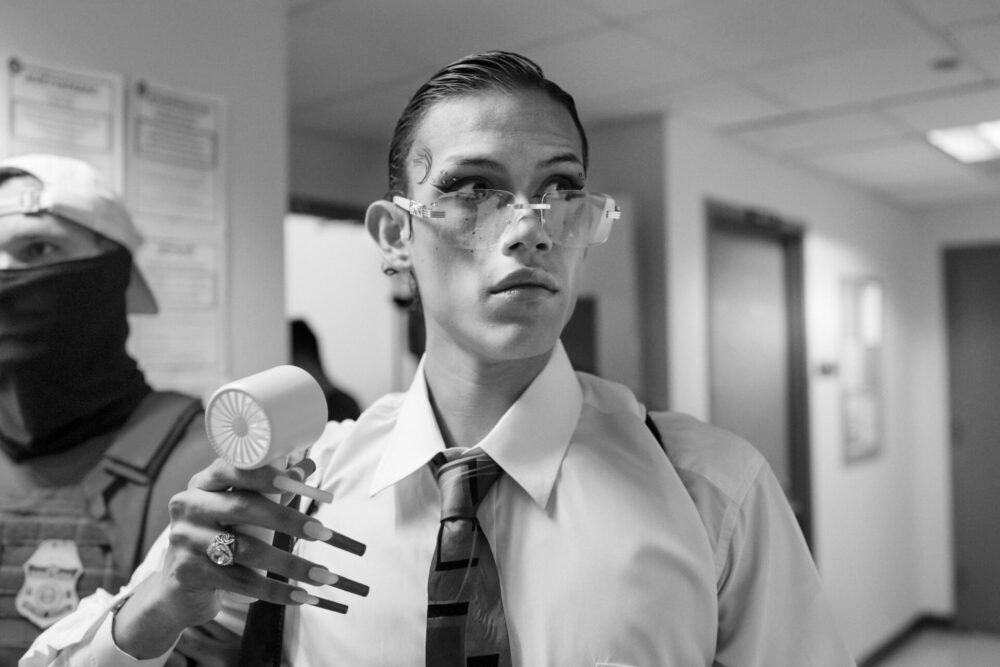
At the Jacob K. Javits Federal Building, at 26 Federal Plaza in Manhattan, a transgender woman — dressed formally for her hearing, carrying a small hand fan — is detained by federal agents as she steps out of the courtroom. In February 2025, ICE stopped publishing data on transgender detainees, despite a congressional mandate to report it. Advocacy groups say this erasure makes those most vulnerable effectively invisible, even as they face higher risks of abuse, medical neglect, and solitary confinement inside detention. For many, hearings end not with resolution but with arrest and transfer to distant facilities in other states — far from their families, communities, and legal counsel. © Nicolò Filippo Rosso
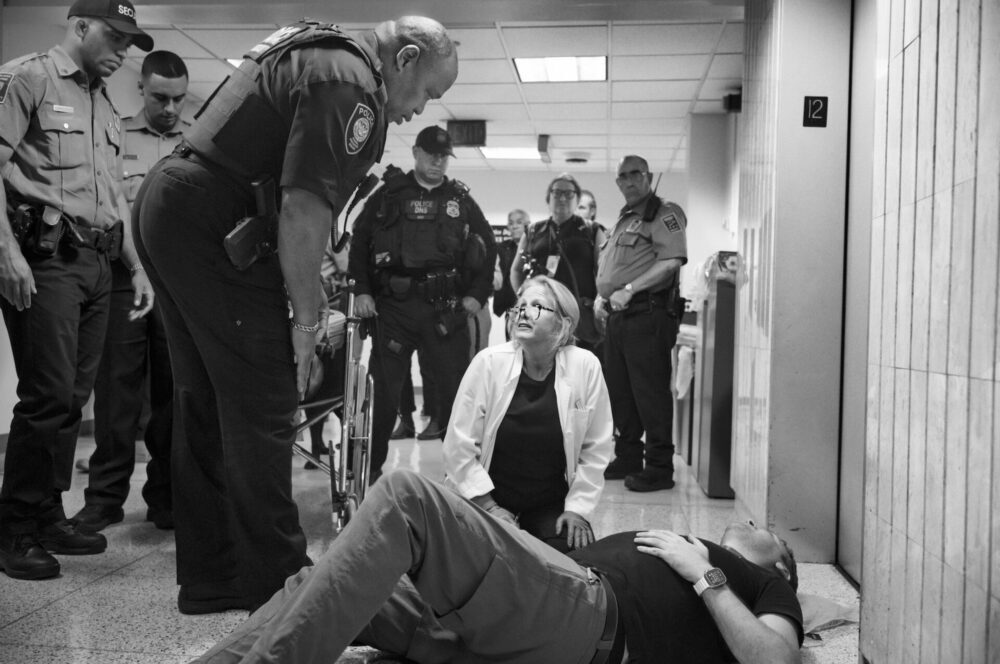
At the Jacob K. Javits Federal Building, at 26 Federal Plaza in Manhattan, DHS Commander Welsh listens as a doctor explains that visual journalist L. Vural Elibol of Anadolu Agency, lying on the floor, has to be taken to the hospital after striking his head. Elibol was injured when federal agents shoved journalists off an elevator to prevent them from documenting an arrest. Afterward, federal officers warned reporters that any interference would result in arrest, creating an atmosphere of fear among the press. In 2025, the Trump administration barred the Associated Press from White House events, signed an order to strip NPR and PBS of federal funding, and escalated rhetoric against journalists. The crackdown at 26 Federal Plaza reflected how enforcement extended beyond migrants, suppressing those who sought to hold power to account. © Nicolò Filippo Rosso
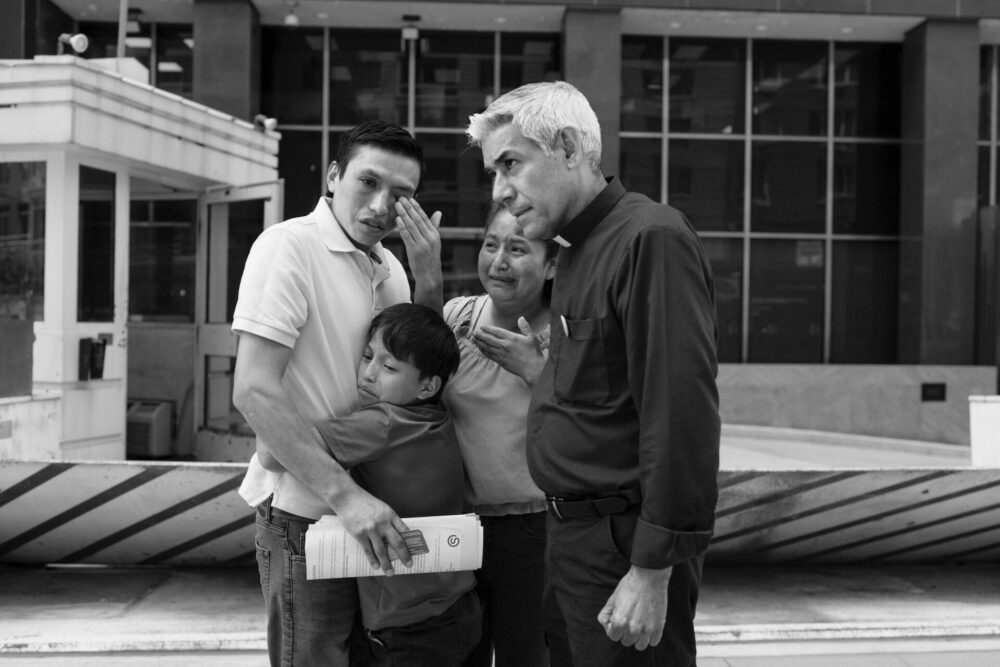
Father Fabian Arias (right) accompanies migrants to their hearings at the Federal Plaza courthouse each week, often standing beside families in their most vulnerable moments. On July 22, 2025, Johnny P., an Ecuadorian migrant, was taken into custody after his hearing but released minutes later under unclear circumstances. Outside, his wife and son, who had been waiting in fear, wept when they saw him return. That evening, the family traveled back to New Jersey before beginning their nightshift jobs in an upstate New York department store. By mid-2025, ICE was detaining nearly 60,000 people daily, almost half without criminal convictions, making Johnny’s release the exception rather than the rule in courthouse arrests. © Nicolò Filippo Rosso
Franyelis Milagro Parra Olivares, 28, from Venezuela, speaks on the phone outside the Jacob Javits Federal Building at 26 Federal Plaza after her husband, Yonqueneide José Yajure Parra, 27, was detained following his immigration hearing. Beside her stands Yoneifer, their 8-year-old son. She is also the mother of Emmanuel, 4, and is pregnant with her third child. Her husband had been the family’s primary provider and caregiver. Now, with his sudden detention, she must navigate both motherhood and survival alone. Father Fabian and allied organizations have helped her access health insurance, psychological support, and legal aid to file a motion in his defense. In 2025, Venezuelans remain the second- largest nationality seeking asylum in the United States, with more than 400,000 cases pending nationwide. Pregnant women and mothers with young children are not spared from these consequences: even when not detained themselves, they are left to shoulder economic, emotional, and caregiving burdens, embodying the collateral damage of immigration enforcement. © Nicolò Filippo Rosso
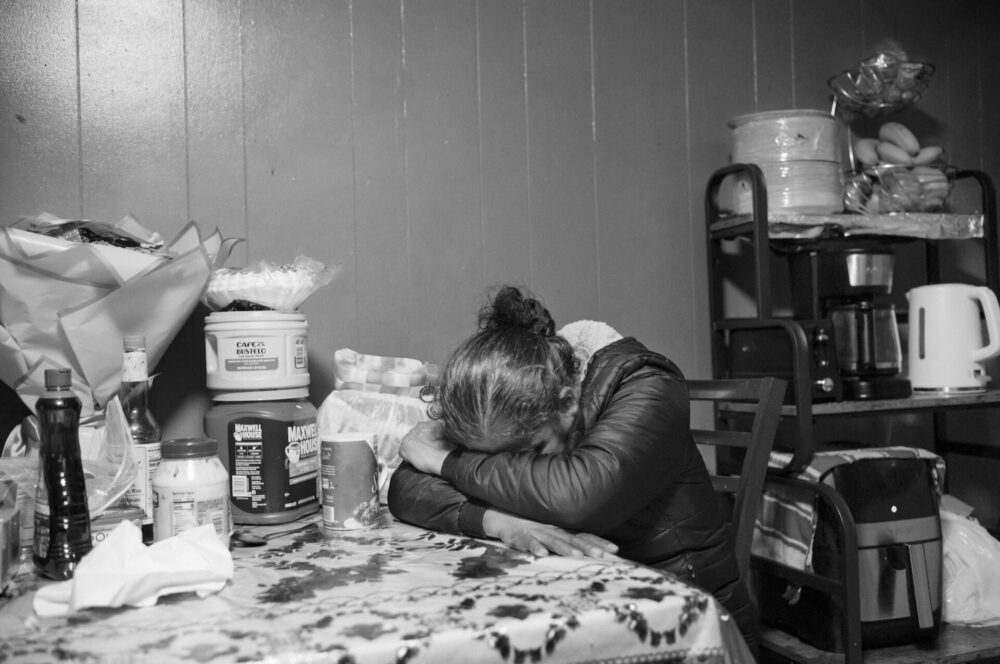
María lowers her head onto her arms at the kitchen table, overwhelmed by the weight of months spent caring for five grandchildren while her daughter Nuvia remains detained by ICE. Since the arrest, the household has relied on her steadiness — meals, school schedules, consoling children after difficult days — yet the strain accumulates, surfacing in rare moments like this when the house grows still. At fifty-seven, María has stepped back from outside work to care for the children full-time, a responsibility made heavier by the uncertainty surrounding her daughter’s case. The kitchen, crowded with food and essentials, has become the center of the family’s efforts to hold itself together. It is where phone calls with lawyers are taken, where updates from detention facilities are parsed, and where prayers are whispered when the children are asleep. Nuvia has been held for more than six months without criminal charges, one of nearly 60,000 people detained daily in a system where court backlogs and transfers often sever communication between families and those detained. For María, the emotional toll is layered: fear for her daughter’s safety, exhaustion from caregiving, and the daily task of reassuring children who ask when their mother will return. The immigration system’s delays — part of more than 3.5 million pending cases nationwide — leave families in prolonged limbo, navigating profound instability inside their own homes. © Nicolò Filippo Rosso
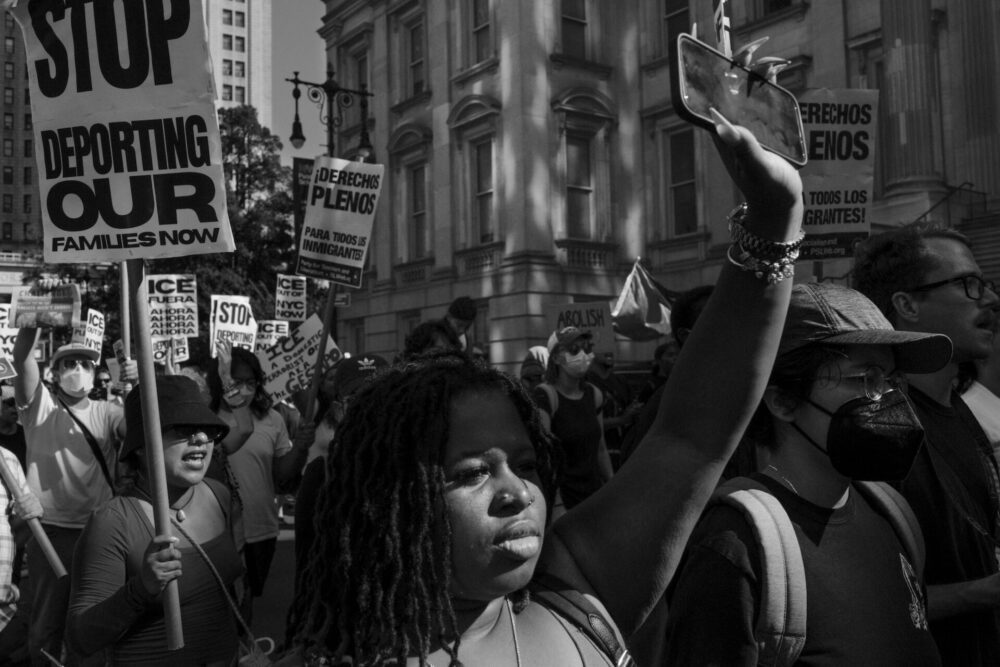
Demonstrators march through Manhattan against Trump’s immigration policies and ICE deportations, demanding an end to family separations and full rights for immigrants. Their banners—“Stop Deporting Our Families Now”— connect the struggle of migrants to broader questions of democracy and equality in the United States. © Nicolò Filippo Rosso
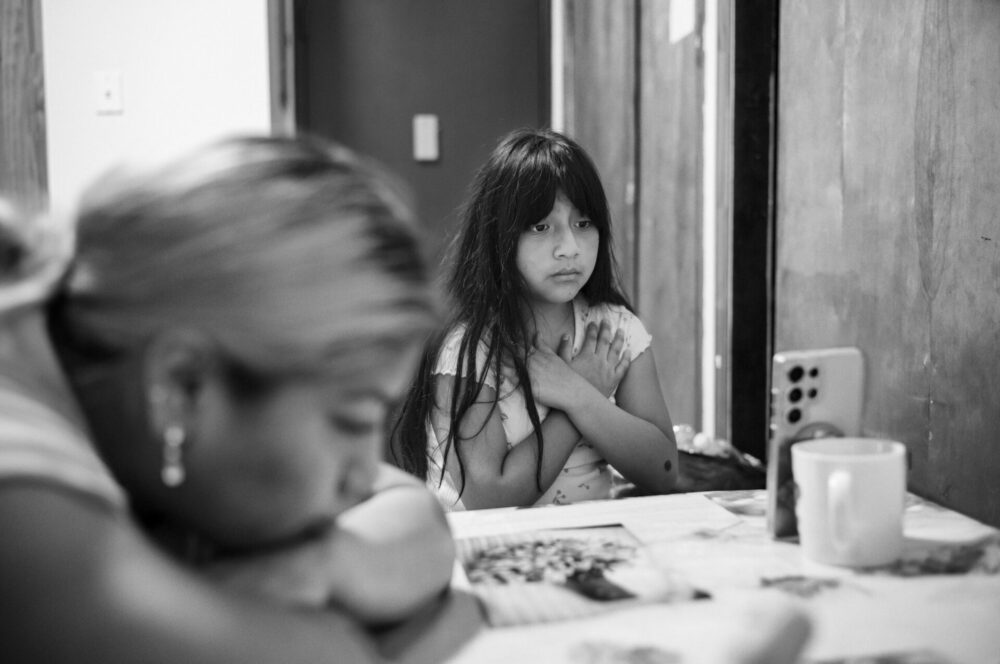
Scarleth, 10, practices the butterfly technique during a remote therapy session, while her mother, Ana Lucía Guaman Buri, listens beside her in their Brooklyn apartment. The method, widely used in trauma therapy, asks the child to cross her arms over her chest and gently tap her shoulders in alternating rhythm, like the wings of a butterfly. Each tap helps ground her body, ease anxiety, and create distance from overwhelming memories. Scarleth, whose biological father was assassinated in Ecuador, witnessed the detention of her father-in-law by ICE after their hearing. The only provider for the family, Rodrigo, father of Scarleth’s 4-year-old sister, Ashley, was later deported to Ecuador. Since his detention in the hallways of the Jacob K. Javits Federal Building at 26 Federal Plaza, Ana has carried the household alone. Weekly therapy helps the family process what they witnessed and navigate the separation. In the absence of state protection, community organizations and church networks provide support, offering therapy, legal aid, and accompaniment. Their role has become essential in New York, where thousands of families rely on small nonprofits to face hearings and cope with the aftermath of detention. In 2025, as ICE arrests surged again, demand for these services far outstripped capacity, leaving many without representation and deepening the divide between families supported by civil society and those left entirely alone. © Nicolò Filippo Rosso

Photographer: Nicolò Filippo Rosso
Nationality: Italian
Based in: Italy
Website: nicolofilipporosso.com
Instagram: @nico.filipporosso

Nicolò Filippo Rosso (1985) is a photographer whose work examines social, environmental, and humanitarian issues across the Americas, the Middle East, and Africa. In 2021, he received the W. Eugene Smith Memorial Fund for Humanistic Photography, and in 2024, the Alexia Grant. His work has also been recognized with two Getty Editorial Grants, seven Pictures of the Year International awards—including the 2024 World Understanding Award—four NPPA Best of Photojournalism awards, a National Magazine Award, the International Photography Award for Photographer of the Year (Deeper Perspective, 2020), two World Report Awards, the Premio Ponchielli, the Romano Cagnoni Award, the Prix ANI-PixTrack, and a World Press Photo.